



Xray is transitioning into a Forge App, Atlassian's modern cloud development platform, using Forge Remote to strengthen security, align with Atlassian's long-term roadmap, and support future innovation.
If you're wondering what the Xray Forge migration means, the short answer is simple: your testing workflows stay exactly the same. The changes happen behind the scenes, improving the platform that powers Xray while maintaining the features, scalability, and performance your team relies on.
Test management lives at the center of DevOps workflows and heavily impacts how teams ship software, so the platform it runs on matters. As Atlassian evolves its Cloud ecosystem, Marketplace apps also need to evolve to remain performant, secure, and aligned with future platform capabilities.
Today we're sharing an upcoming change that strengthens that foundation: Xray has begun migrating to Atlassian Forge, adopting Forge Remote as the bridge between Atlassian's Cloud and your QA system of record.
This isn't a new feature you'll need to learn or a workflow you'll need to adopt. Your experience of using Xray stays the same. What changes is everything happening underneath: how the app is built, secured, and how quickly we can build what's next.
Here's why we are making the move and what you’ll get out of it.
From Connect to Forge: a quick overview
Atlassian apps have historically been built on Connect, a framework where the app runs on the vendor's own external servers and exchanges data with your Atlassian instance. It works, but it puts the burden of hosting, scaling, and securing infrastructure on the vendor.
Forge is Atlassian's modern cloud development platform. Apps run inside Atlassian's own infrastructure, in isolated, sandboxed environments with security controls enforced by the platform itself. Atlassian has signaled that Forge is the future of its Cloud ecosystem, and has set the end of life for the Connect framework for the end of 2026.
For Marketplace vendors, adopting Forge is no longer simply about accessing new platform capabilities, it is also about ensuring long-term compatibility with Atlassian Cloud and preparing for the future of the ecosystem.
For Xray customers, however, this migration will be largely invisible. The goal isn't to change how you manage testing; it's to strengthen the technology that supports it.
Forge Native vs. Forge Remote
Within Forge, there are two ways to build, and the key difference comes down to one question: where does the app's backend code actually run?
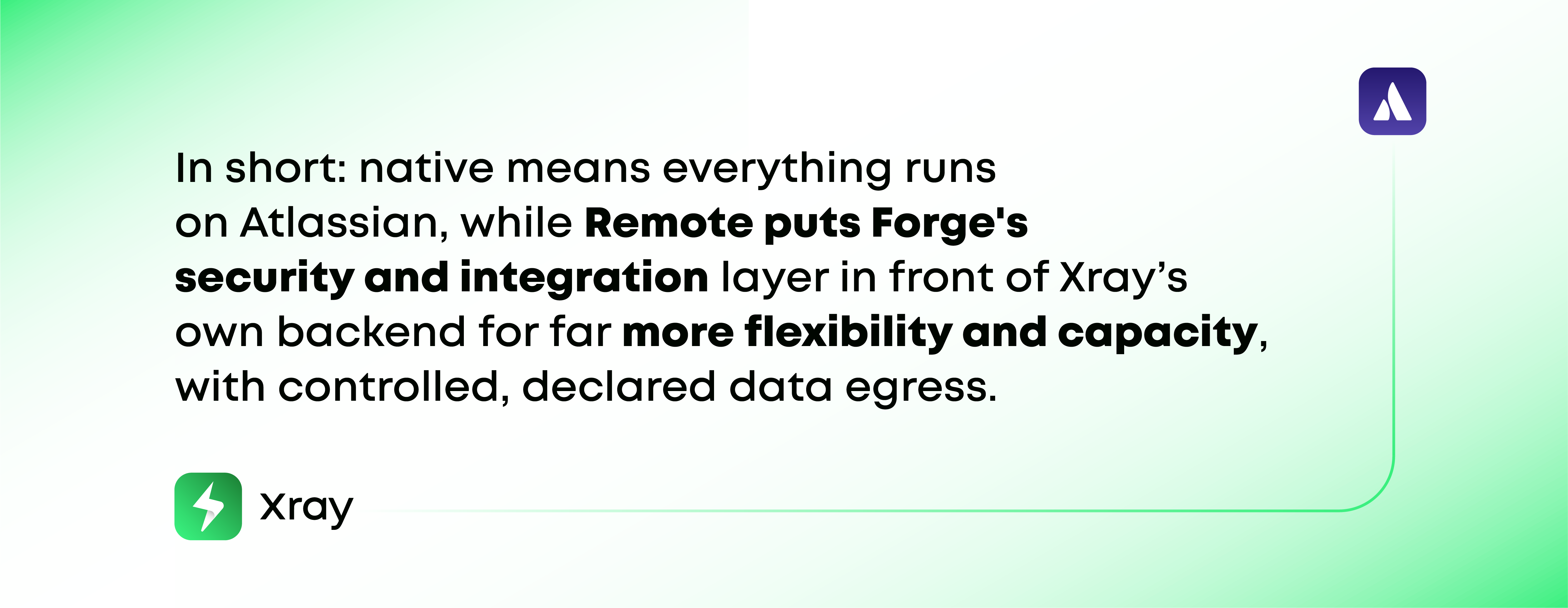
With Forge native, the entire app runs inside Atlassian's infrastructure, on Forge-hosted functions and Forge-hosted storage. This is what earns an app the "Runs on Atlassian" badge, because there's no data egress (or alternatively customer-managed egress) and data residency is handled automatically.
With Forge Remote, the Forge app acts as a secure bridge to a backend run by Xray, outside Atlassian. Atlassian hosts the UI and integration layer, while the heavy compute and data live on Xray’s infrastructure. Every external endpoint is declared up front in the app manifest and governed by Forge's egress controls. Although we don't get the "Runs on Atlassian" badge, because our services still run within our infrastructure, we do get Forge's security model in front of a mature, full-featured backend.
Forge Remote is the piece that makes this practical for a sophisticated app like Xray. A full-featured test management engine carries substantial compute, storage, and existing service logic that isn't practical to fully re-platform onto Forge-hosted functions (even though we’ll be using a few such as the auth token management for Forge Remote). Forge Remote lets the Forge side of the app communicate securely with that dedicated backend, with the external endpoints declared explicitly in the manifest and enforced by Atlassian's egress controls. That means Xray gets the security and trust posture of Forge while keeping the depth of functionality that complex test management demands.
What you actually get
Forge-grade security in front of a full-featured backend
Forge Remote means every connection between Xray's Forge layer and its backend is declared up front in the app manifest and enforced by Atlassian's egress controls. The app can't quietly reach anywhere it hasn't explicitly listed. So even though the heavy lifting happens on a dedicated backend rather than inside Atlassian, that backend now sits behind Forge's security model: defined endpoints, reviewable boundaries, platform-enforced rules, and permissions scope (meaning that Jira admins need to explicitly prove any changes in scope).
For your security and procurement teams, this is the difference between "trust the vendor's word" and "verify it against Atlassian's controls", without giving up any of the depth a serious test management engine needs.
Full backend power, with no platform ceiling
This is where Forge Remote really earns its place. Because Xray's compute and storage run on a dedicated backend rather than on Forge-hosted functions and Storage, the app isn't constrained by native Forge's platform limits. That headroom is what lets Xray handle test suites that grow into the tens or hundreds of thousands of cases, with the performance and reliability that scale demands — all while still presenting through Forge's integration surface.
Faster innovation without a risky rewrite
Forge Remote lets us modernize how Xray plugs into Atlassian Cloud without re-platforming the entire engine you depend on. We kept the mature backend that powers your testing and put a modern, secure Forge layer in front of it. Less time spent rebuilding what already works well is more time spent on the capabilities that actually move your testing forward, and a faster path to the next wave of Xray improvements.
Future-proof and aligned with Atlassian's roadmap
With Connect winding down, Forge Remote keeps Xray fully aligned with where Atlassian Cloud is heading while preserving the depth of a dedicated backend. Choosing Xray means choosing an app that's invested in the platform's long-term direction rather than one playing catch-up. You won't face a disruptive forced migration down the line, because the work is already done.
What this means for your team
The short version: nothing breaks, and several things quietly get better.
Your Tests, Test Executions, Requirement coverage, and reporting all stay where they are. The interface you use day-to-day is unchanged. Behind the scenes, your test management now runs on an architecture that's more secure, more compliant-ready, and better positioned for the future.
If you're an admin or buyer evaluating apps, this move is worth weighing in your assessment. An app built on Forge gives you clearer answers to the questions that matter most in a security review: where does our data go, who can reach it, and can we prove it.
Migrating a platform as deep as Xray to Forge Remote is a significant engineering investment, and we are making it deliberately. It reflects a simple belief: the tools you trust with your testing should be built on the most secure, durable foundation available.
We'll continue to share updates about the progress of the Xray migration to Forge Remote in the months ahead.
For now, there's nothing you need to do. Just keep testing, with the confidence that the ground underneath you is more solid than ever.
FAQ: Xray's migration to Atlassian Forge
What is Atlassian Forge?
Atlassian Forge is Atlassian's cloud app development platform for building secure Marketplace apps that integrate with Jira Cloud and other Atlassian Cloud products. It provides built-in security controls, permission management, data governance, and a standardized framework for developing cloud applications.
Forge is also the strategic direction for Atlassian Cloud. As Atlassian phases out the Connect framework, Marketplace vendors are transitioning their applications to Forge to remain aligned with the platform's future.
Why is Xray migrating to Atlassian Forge?
Xray is migrating to Atlassian Forge to align with Atlassian's long-term Cloud platform strategy, strengthen security, and provide a future-ready architecture. By adopting Forge Remote, Xray combines Forge's security model with the scalability and performance of its existing backend, allowing the product to continue supporting complex enterprise testing scenarios.
What is Forge Remote?
Forge Remote is an architectural model within Atlassian Forge that allows an app's user interface and integration layer to run on Forge while its backend services remain on the vendor's infrastructure. This approach enables Xray to benefit from Forge's security and governance while maintaining the compute power, storage, and functionality required for enterprise-scale test management.
What is the difference between Forge Native and Forge Remote?
Forge Native runs an application's backend entirely within Atlassian's infrastructure using Forge-hosted functions and storage.
Forge Remote uses Forge for authentication, permissions, and integration with Atlassian Cloud while allowing backend services to run on dedicated vendor infrastructure. This provides greater flexibility and scalability for applications with complex workloads, such as Xray.
Will the migration to Forge change how I use Xray?
No. Your testing workflows, projects, Tests, Test Executions, Requirements, reports, and overall user experience remain unchanged. The migration only affects the underlying architecture that powers Xray.
Does the Forge migration require any action from customers?
Yes. The upgrade is now available and must be manually approved by a Jira administrator on your instance. Once approved, Xray users can continue working as usual, with no changes to workflows or functionality.
If you have additional questions, check our extended Xray's Migration to Atlassian Forge - FAQs.